Solutions / IT Operations
IT OPERATIONS
Know what you own, who has it, and what it costs, without the spreadsheet.
Reconcile what your ITSM, endpoint, identity, HR, and procurement systems each know into one verified record per asset, so onboarding, offboarding, license reclaim, and audit requests run on data you can trust instead of manual checks.
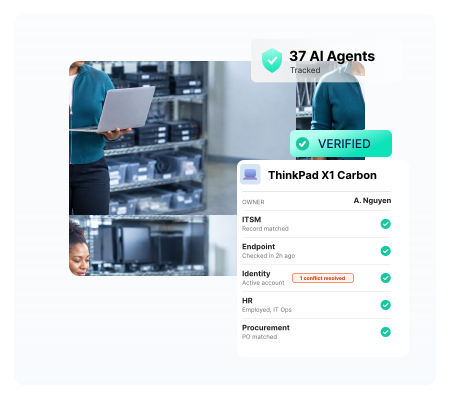
Every system knows part of the asset, but none of them knows all of it.
Your help desk, MDM, identity provider, and HR system each track the same assets differently, and AI tools and agents now add a new layer of assets and spend. When those systems disagree, no one knows which one is right, so Oomnitza reconciles every source into one verified record per asset your team can act on.
TRUST
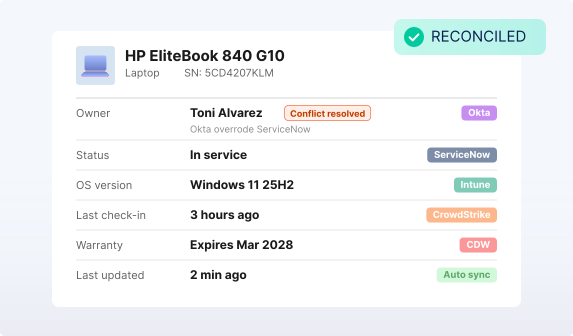
Reconcile every system IT depends on into one verified record, even when they disagree.
ITSM, MDM, EDR, identity, HR, procurement, and now AI tools each hold a different piece of the same asset, and they rarely agree. Oomnitza resolves the conflicts automatically, so a device reassigned last week shows up correctly everywhere, not just in the one system that got updated.
ACT
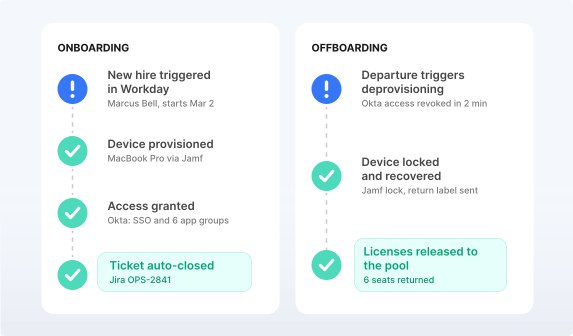
Automate onboarding and offboarding, and route incidents and changes to the right asset and owner.
New hires, departures, and incident tickets each kick off their own workflow, so devices and accounts are ready on day one and access is revoked the moment someone leaves. Departing employees’ devices are located and locked or recovered, so hardware and licenses don’t sit assigned to people who are gone.
LEAD
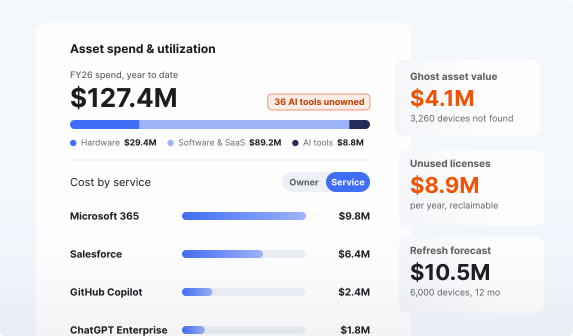
Know what IT really costs, including AI, and where to cut.
See hardware, software, SaaS, and AI tool spend by owner in one place. Spot ghost assets, unused licenses, and unowned AI subscriptions, answer audit and security requests without a fire drill, and bring a number you can defend to budget conversations and refresh planning instead of last quarter’s spreadsheet.
RELATED SOLUTIONS
Onboard faster, recover what’s wasted, and know what you’re spending.
|
|
|
| EXPLORE THE SOLUTION | EXPLORE THE SOLUTION |
|
|
|
| EXPLORE THE SOLUTION | EXPLORE THE SOLUTION |


CUSTOMER STORY
A lean IT team that scaled without adding headcount.
 |
|
| “We wouldn’t be able to stay the same size IT team if we didn’t have Oomnitza. We would probably need someone solely managing assets and shipping stuff out, so there’s a massive impact from [everything happening automatically].”
– Fiona McShane, Senior Automation Engineer
|
|
5 minutesNew-hire onboarding time, down from 4 hours. |
98%+Reconciliation between MDM and inventory records, supporting SOC 2 audit readiness. |
| READ FULL STORY | |
INTEGRATIONS
Connect every system IT operations already runs on.
ITSM, endpoint management, identity, HR, procurement, and security tools each hold a different piece of the same asset. Oomnitza reconciles what they know into one verified record IT operations can act on, without replacing the tools you already use. If a system isn’t in the library, Oomnitza’s flexible data model and API framework can connect it.











1,500+ prebuilt turnkey connectors across ITSM, endpoint, identity, HR, procurement, and cloud.
Keep Exploring

Table of ContentsJTVCYmxvZ190b2MlNUQ=KEY TAKEAWAYS1. Most enterprise ITAM programs treat asset management as an inventory problem when it is actually a data quality and governance problem. Only 35.9% of organizations report…
Table of ContentsJTVCYmxvZ190b2MlNUQ=KEY TAKEAWAYS 1. ServiceNow ROI is directly dependent on CMDB accuracy, and CMDB accuracy degrades the moment it's updated. Manual hygiene processes cannot keep pace with the rate…
Frequently Asked Questions
Why does IT asset data accuracy matter to IT operations teams?
Accurate asset data matters because every onboarding, offboarding, incident, change, and audit request depends on knowing what an asset is, who has it, and what state it’s actually in. When ITSM, endpoint, identity, and HR systems don’t agree, tickets get routed to the wrong owner, changes get planned against outdated configurations, devices and licenses stay assigned after people leave, and onboarding stalls while someone tracks down the real answer. Accurate asset data turns those moments into quick, confident actions instead of manual investigation.
How does Oomnitza reconcile ITSM, endpoint, identity, and HR data, and what happens when sources disagree?
Oomnitza connects to the systems that each hold a piece of the picture through 1,500+ agentless, prebuilt turnkey connectors and reconciles them into one verified record per asset. It compares what’s deployed, who has access, who’s employed, and what’s logged in the ticketing system, resolves conflicts automatically, and updates the record as the source systems change.
How is Oomnitza different from the asset module in your ITSM or a discovery tool?
Oomnitza works alongside your ITSM and discovery tools rather than replacing them. An ITSM asset module or discovery tool sees part of the environment. Oomnitza reconciles data from all of them, plus HR, identity, and procurement, into one verified record, and feeds that record back to the tools your team already uses. You keep your existing systems and gain accurate data and automated workflows across them.
What are ghost assets, and how do they slow down IT operations?
New text: Ghost assets are devices or licenses still recorded as active that can no longer be found or confirmed in use, such as a laptop that never came back from a departed employee or a device that hasn’t checked in for months. They waste time on tickets routed to the wrong device, inflate inventory counts, and make refresh and capacity planning unreliable. Oomnitza continuously reconciles hardware and software records against actual usage, so ghost assets surface and get recovered, reassigned, or retired.
How does Oomnitza automate onboarding and offboarding, and reclaim devices and licenses?
Oomnitza connects to HR systems like Workday and BambooHR, so a new hire or departure triggers the right workflow automatically. For a new hire, it provisions a device and access ahead of day one. When someone leaves, it deprovisions the user, finds and locks or recovers their device, and flags the software and licenses tied to that person for reclaim. IT operations doesn’t have to open a ticket to start the process or confirm it closed. Docker uses this to deprovision users and lock devices in Jamf automatically.
How does Oomnitza track AI tools and agents as IT assets?
Oomnitza tracks AI tools and agents the same way it tracks other assets: by reconciling data from the systems that already see them. They show up through the same connectors as the rest of your stack, so they land in the same verified record and are assigned to an owner like any other asset. That gives IT one place to see which AI tools are in use, who owns them, and what they cost.
Does Oomnitza require an agent, and how much effort does it take to get started?
No. Oomnitza is agentless and connects through APIs to the systems you already run, so there’s nothing new to install on endpoints. You authenticate your systems, start with a prebuilt integration package or a single workflow, and expand from there. Many teams start with one problem, such as offboarding or license cleanup, and prove it in a sandbox or proof of concept first.
How does Oomnitza support refresh planning, lifecycle management, and spend visibility?
Oomnitza keeps device age, warranty status, support status, utilization, and cost current across every endpoint, so aging and high-risk hardware surfaces before it causes an outage. Refresh cycles and budget requests can be built on current data instead of a manual inventory check. At Docker, Oomnitza dashboards let the team set an 80% asset utilization goal, something it couldn’t measure before.
How does Oomnitza help IT answer audit and security requests?
Oomnitza gives IT one verified record of every asset, with its owner, state, and change history, so an audit or security request becomes a report instead of a project. Docker reached 98%+ reconciliation between MDM and inventory records for SOC 2 and now saves dozens of hours of audit prep time.
Can Oomnitza feed accurate data into your CMDB or ServiceNow instance?
Yes. Oomnitza integrates bidirectionally with ITSM platforms such as ServiceNow, Jira, Freshworks, and Zendesk, reconciling hardware, software, and ownership data upstream and feeding the verified record into the CMDB. Oomnitza doesn’t replace your ITSM platform; it governs the asset data that feeds it.
Ready to see a verified asset record in your environment?
Tell us what’s hardest to keep accurate today, and we’ll show you how teams start.