Oomnitza is priced on the assets you manage and the outcomes you need, not on how many people log in.
Pricing built around your estate,
not your headcount.
OVERVIEW
How Oomnitza pricing works
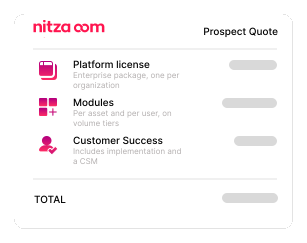
Oomnitza pricing has three components: a platform license that determines which features and integrations you get, usage-based modules priced per asset or per user on volume tiers, and a Customer Success package that includes deployment and ongoing technical account management.
Every quote is built around your environment, so your price reflects the estate you actually manage rather than a fixed per-seat rate.
PLATFORM
Which platform package do you need?
Two packages. Enterprise is required for software asset management, MCP and AI agent workflows, data archive, and any use case that writes data back to a connected system.
Essentials
Hardware asset management for organizations consolidating onto a single governed asset record.
Annual license · quoted per organization
- Hardware asset management
- Up to 10 integrations
- Read-only API access
- Standard dashboards and reporting
- Software asset management
- MCP and AI agent workflows
- Data archive
Enterprise
Hardware and software governance for multi-system estates with audit, security, or finance accountability.
Annual license · quoted per organization
- Everything in Essentials
- Software asset management
- Unlimited integrations
- Read and write API access
- MCP support for AI agent workflows
- Data archive
- Write-back to connected systems
MODULES
Which modules can you license?
Modules are the second component of a quote. You license only the asset classes you actually track, and each one is counted on its own basis.
| MODULE | WHAT IT COVERS | HOW IT IS PRICED |
|---|---|---|
| Assets | Endpoints, servers, virtual machines, network hardware, printers, IoT and OT devices, cloud compute. | Per asset, per year, volume tiers |
| Peripherals | Serialized devices tracked individually: monitors, keyboards, mice, webcams. | Per device, volume tiers |
| Accessories | Non-serialized stock tracked by quantity and type: cables, adapters, docking stations. | Flat rate at any volume |
| Software | Installed, SaaS, and cloud software: entitlements, deployments, usage, reclamation, and renewal position. | Per user, on volume tiers |
| Guard | Anomaly and risk detection: shadow IT, catalog mismatches, and unusual asset behavior across every asset class. | Matches your asset count |
CUSTOMER SUCCESS
What support is included?
All three tiers include implementation and an assigned Customer Success Manager. Workflow count, custom objects, and integration volume determine which one your deployment needs.
Standard
First deployments and standard hardware asset management scope.
Assigned CSM · monthly cadence
- Implementation included
- Assigned Customer Success Manager
- Out-of-the-box integrations configured
- Custom dashboards and reporting
- Onboarding and offboarding automation
- Annual health check
Advanced
Multi-platform environments adding software governance and complex lifecycle workflows.
CSM and pooled TAM · biweekly cadence
- Everything in Standard
- Pooled technical account management
- Complex onboarding and offboarding
- Legal hold, e-waste, barcode scanning
- Stockrooms and accessories management
- MCP integration for AI agent workflows
- Custom integrations built during implementation
Enterprise
Large, multi-entity estates with heavy integration and chargeback requirements.
CSM and dedicated TAM · weekly cadence
- Everything in Advanced
- Dedicated technical account management
- Multi-site and multi-country tracking
- IT finance chargeback and showback
- Expanded custom integration scope
- Quarterly health checks and executive briefings
What is included in every plan?

Implementation
Deployment is included in all three Customer Success tiers. There is no separate implementation contract to negotiate before the platform is operational.

An assigned Customer Success Manager
Every customer is assigned a CSM, including at the entry tier. Technical account management scales from pooled to dedicated as complexity increases.

Unlimited administrators
Oomnitza is not licensed per administrator, per technician, or per agent seat. Adding IT staff, approvers, or report viewers does not change your license cost.

Volume-tiered rates
Asset, peripheral, and software licenses sit on volume tiers. The rate per unit decreases at each tier, so the cost per asset falls as the estate grows.
CUSTOMER RESULTS
What do customers get back?

CHG Healthcare
$0 spent on new laptops in 2025, by recovering devices from off-boarded employees.

PDS Health
25% saved across the lifecycle of every asset, and 160 hours back each month.

Docker
98%+ asset data accuracy behind SOC 2, and 97% less time onboarding a new hire.
BUYER’S GUIDE
How should you compare ITAM pricing across vendors?
Normalize the unit of measure first. IT asset management vendors price on fundamentally different units, which makes advertised rates misleading until each one is modeled against the same environment.
| PRICING UNIT | YOUR COST RISES WHEN... |
|---|---|
| Per technician or agent | Your IT team grows, even if the estate stays flat |
| Per asset or per device | Your estate grows |
| Per user | The number of people consuming software entitlements grows |
| Per employee | Your headcount grows, regardless of how many devices you issue |
| Per admin seat | More people need access to the system |
| Flat platform fee | Typically at renewal, or at a scale threshold set by the vendor |
Four questions to ask any vendor
A per-agent price and a per-asset price cannot be compared until both are modeled against your actual asset count, user count, and integration list. These four answers move the total far more than the headline rate does.
01
What is the unit, and what happens if that unit doubles?
Ask for the same environment priced at twice the count. The gap between the two numbers tells you what you are actually buying.
02
Does the unit price decline at volume?
Ask where the breakpoints sit and to see them in the contract. A rate that only improves at renewal is not volume pricing.
03
Is implementation included?
If it is a separate statement of work, get its scope and cost before you compare license fees.
04
What sits outside the license?
API access, sandbox environments, on-premises connectors, premium support, and add-on modules are where cost usually hides.
NEXT STEPS
How do you get a quote?
A 60-minute scoping call produces a written quote. Bring your asset counts and the list of systems you need connected.
1
Scoping call
Roughly 60 minutes. Covers asset counts, geographic distribution, the systems you need integrated, and whether you require write-back, procurement integration, or AI and MCP workflows.
2
Solution design
Your requirements are mapped to a platform package, a module mix, and the Customer Success tier that matches your workflow and integration complexity.
3
Written quote
Every component itemized, valid for 30 days. Proof-of-concept engagements are available once both sides have confirmed the budget is realistic.
Frequently Asked Questions
How much does Oomnitza cost?
Oomnitza pricing is scoped to each environment rather than sold from a fixed price list. A quote is built from three components: a platform license, usage-based modules priced per asset or per user on volume tiers, and a Customer Success package that includes implementation. Oomnitza is built for enterprise and mid-enterprise estates, and pricing reflects that scale. A 60-minute scoping call produces a written quote.
Is Oomnitza priced per user or per asset?
Both, depending on the module. Hardware asset management is priced per managed asset per year. Software asset management is priced per user, because software entitlements are consumed by people rather than devices. Neither is tied to the size of your IT team.
Does Oomnitza charge per administrator or per technician seat?
No. Oomnitza is not licensed per administrator, per technician, or per agent seat. Adding IT staff, approvers, or report viewers does not increase your license cost. Gartner has noted that most organizations in this segment operate without dedicated ITAM staff, and the licensing model reflects that.
Does the price per asset decrease as we add assets?
Yes. Asset, peripheral, and software licenses are priced on volume tiers, so the unit rate steps down at each successive tier. Organizations at the top volume tier pay a materially lower per-unit rate than those at the entry tier. Accessories are the exception and are priced at a flat rate regardless of volume.
What is the difference between the Essentials and Enterprise platform packages?
Essentials covers hardware asset management with read-only API access and up to ten integrations. Enterprise adds software asset management, MCP support for AI agent workflows, data archive, read and write API access, and unlimited integrations. Enterprise is required for SAM, MCP, data archive, and any use case that writes data back to a connected system.
Is implementation included, or is it a separate cost?
Implementation is included in all three Customer Success tiers, alongside an assigned Customer Success Manager and ongoing technical account management. Work outside your scoped tier, such as additional workflows, integrations beyond your tier limit, or bespoke training, is quoted separately as professional services.
Do integrations cost extra?
Integrations are not a separate line item. Essentials includes up to ten integrations and Enterprise is unlimited. Net-new custom connectors are built by Oomnitza during implementation and are available on the Advanced and Enterprise Customer Success tiers.
Can we start with hardware asset management and add software later?
Yes. Modules are licensed independently, so most organizations begin with hardware and add software asset management, peripherals, accessories, or Guard as the program matures. Adding software asset management requires the Enterprise platform package, which is worth planning for in advance.
Is Oomnitza a fit for small IT teams?
Team size is not a barrier, because nothing is licensed per administrator. Estate size is the relevant question. Oomnitza is designed for enterprise and mid-enterprise environments where multiple systems hold asset data. An organization managing a few hundred assets from a single source of record is generally better served by a lighter-weight tool.
Does Oomnitza offer a free trial or a proof of concept?
There is no self-serve free trial. Evaluation happens through a proof of concept configured against your own systems and data, typically running two to three weeks. A POC begins once both sides have confirmed that the budget range is realistic, so that neither party invests time in an engagement that cannot close. A self-guided product tour is available for a faster first look.
How should we compare Oomnitza pricing to other ITAM vendors?
Normalize the unit of measure first. ITAM and ITSM vendors price on different units, including per technician, per asset, per device, per employee, and flat platform fees, so headline rates are not directly comparable. Model each vendor against the same environment using your actual asset count, user count, and integration list. Then confirm what sits outside the license, including implementation, API access, sandbox environments, on-premises connectors, and premium support.
How long is a quote valid?
Quotes are valid for 30 days. Extensions are available on request where a procurement cycle requires more time.
Get a quote scoped to your estate.
Tell us what you manage and we’ll show you what it costs. Most scoping calls take about 60 minutes.