
Solutions / Finance & Procurement
FINANCE & PROCUREMENT
Make IT spend the most predictable line in the budget.
Forecast refresh and renewals from headcount growth, warranty dates, and actual software use, so the budget starts from proof instead of last year’s invoice.

Proof of purchase isn’t proof of use.
Procurement holds the contract, IT holds the deployments and usage, and HR holds the headcount. Oomnitza brings them together, so finance can confirm which spend is earning its keep and recover the rest.
TRUST
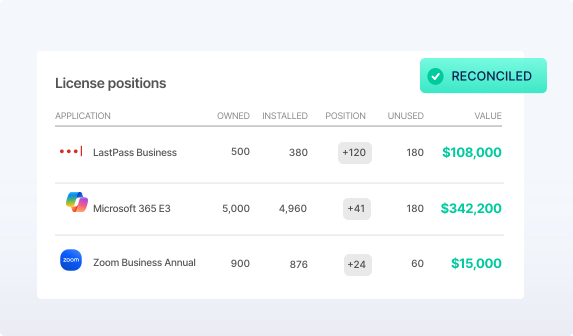
Match what’s on the books to what’s actually in use.
Gartner estimates that 30% of SaaS budgets are wasted on unused licenses and features. Oomnitza compares what procurement bought against what IT shows is deployed and used, so idle licenses and missing devices surface with a cost attached.
ACT
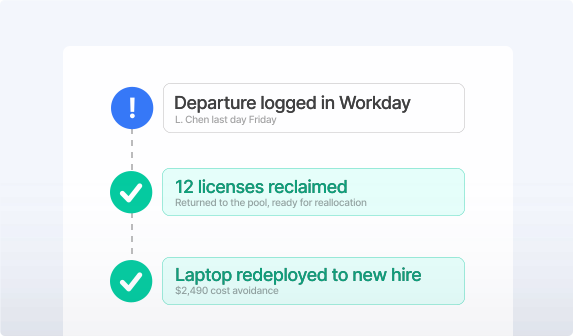
Recover idle assets before they cost you another budget cycle.
Departures, idle licenses, refresh dates, and upcoming renewals each start their own follow-through, so seats are reclaimed and devices come back to stock without anyone opening a ticket.
LEAD
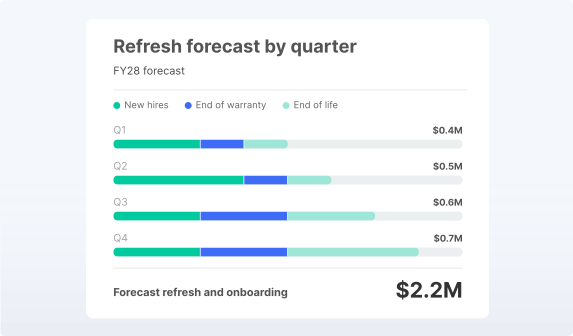
Forecast IT spend from headcount, warranties, and real use.
Oomnitza combines hiring plans from HR with warranty and end-of-life dates on every device, so finance can see what refresh and onboarding will cost and when. Renewals are sized to actual utilization, so next year’s budget holds up under review.
RELATED SOLUTIONS
Unlock faster audits, lower spend, and tighter security
across the business.
|
|

Asset Visibility & OwnershipSurface every app in use, sanctioned or not, and tie each license to a named owner and a cost center. |
| EXPLORE THE SOLUTION | EXPLORE THE SOLUTION |
|
|
|
| EXPLORE THE SOLUTION | EXPLORE THE SOLUTION |


CUSTOMER STORY
Scaling smarter: a leading global financial analytics firm rethinks software spend.
| “Looking at assigned licenses and active logins in one simple chart is really powerful in helping us save money and time.”
– Director, Corporate Services
|
|
$150,000Recovered from idle and underused licenses. |
3 secondsTo find software installed on a device, down from 20 minutes. |
| READ FULL STORY | |

INTEGRATIONS
Connect every system that holds a piece of your spend.
Procurement, finance, HR, and IT each know something different about the same asset: what it cost, who it’s assigned to, and whether it’s still in use. Oomnitza reconciles what they know into one verified record.


















1,500+ prebuilt turnkey connectors across endpoint, identity, ITSM, procurement, finance, and HR.
Keep Exploring
Table of ContentsJTVCYmxvZ190b2MlNUQ=KEY TAKEAWAYS 1. Procurement and ITAM systems were built to answer different questions and were never designed to hand off to each other. That structural gap means assets…
Table of ContentsJTVCYmxvZ190b2MlNUQ=KEY TAKEAWAYS Software asset management covers every license, SaaS subscription, and cloud entitlement across its full lifecycle. In 2026, most of that footprint is SaaS that traditional endpoint-based…
Frequently Asked Questions
Why does IT asset data quality matter to finance and procurement teams?
Every budget, renewal, and audit decision depends on knowing what the business owns, who uses it, and what it costs. When asset data is spread across procurement, IT, HR, and finance systems that don’t agree, teams end up paying for assets nobody uses, buying what’s already in stock, and rebuilding numbers by hand before every review. Accurate asset data turns those decisions into evidence-based calls instead of estimates.
Why does IT asset data become inaccurate over time?
Asset data changes every time someone joins, changes roles, or leaves, a device is returned or reassigned, a purchase order is filed, or a contract renews. Each of those events lands in a different system, and those systems rarely update each other. Without continuous reconciliation, a record that was accurate last quarter can be wrong by the next budget cycle.
How does Oomnitza reconcile procurement, finance, HR, and IT data?
Oomnitza connects to the systems that each hold a piece of the picture through 1,500+ agentless connectors. It reconciles what was purchased, what is deployed, what is actually used, and who is still employed into one verified record per asset. That record updates as source systems change, so finance and procurement work from the same numbers as IT.
What are ghost assets, and how do they affect the IT budget?
Ghost assets are items still recorded on the books or still being paid for that can no longer be found or are no longer in use, such as a laptop that never came back from a departed employee or a subscription nobody logs into. They inflate depreciation, insurance, maintenance, and renewal costs. Oomnitza reconciles hardware inventory against your depreciation schedule and surfaces unused licenses, so ghost assets can be recovered, reassigned, or written off with documentation.
How can finance teams reduce spend on unused software and idle hardware?
Oomnitza continuously surfaces idle seats, redundant subscriptions, and devices that are recoverable, then triggers workflows to reclaim, reassign, or cancel them before the next renewal or refresh. One global financial firm recovered $150,000 from idle and underused licenses, and a leading broadband provider saved $712,500 by reclaiming devices from offboarded employees.
How does accurate asset data improve IT budget forecasting?
Forecasts built on last year’s invoices tend to carry last year’s waste forward. With Oomnitza, refresh cycles, upcoming renewals, recovery pipelines, and actual usage stay current across devices, licenses, and cloud, so next year’s budget reflects what the business actually uses and can hold up under review.
How does Oomnitza help procurement prepare for software renewals and vendor negotiations?
Usage, deployment, and contract history are ready before the vendor’s first proposal. Procurement can right-size renewals to real demand, consolidate overlapping tools, and negotiate from evidence rather than the vendor’s numbers. Recovered licenses also go back into the pool, so new requests can draw on what you already own before anything new is purchased.
Can Oomnitza tie IT assets to owners and cost centers?
Yes. Oomnitza ties every hardware asset and software license to a named owner, a cost center, and a lifecycle stage. Finance can see which teams are driving spend, attribute costs accurately, and spot assets that no longer have an active owner.
How does IT asset management support SOX and other financial audits?
Auditors expect a documented record of what the business owns, who holds it, what it cost, and what happened to it over its lifecycle. Oomnitza maintains that evidence continuously and generates documentation aligned to SOX, SOC 2, ISO 27001, DORA, NIS2, and Essential Eight on demand. Customers have cut audit prep from weeks to days by replacing manual spreadsheet reconciliation.
Which finance, procurement, and HR systems does Oomnitza integrate with?
Oomnitza connects to procurement, finance, and HR platforms such as Coupa, Oracle NetSuite, Workday, ADP, and BambooHR, alongside the endpoint, identity, and ITSM tools IT already runs. With 1,500+ connectors, Oomnitza pulls purchasing, cost, and headcount data into the same record as deployment and usage, and can write verified data back to downstream systems.
Ready to put your data to work?
Reach out to see what’s possible.