Oomnitza sits above HR, IT, procurement, security, and finance to govern every hardware decision in one place.

The asset control plane for your entire hardware estate.
Hardware fleets in the most demanding enterprises run on Oomnitza.









Bring every hardware asset under
one source of authority.
Oomnitza is the asset fabric that delivers trusted hardware data to every team and downstream workflow that depends
on it.

Trusted asset data
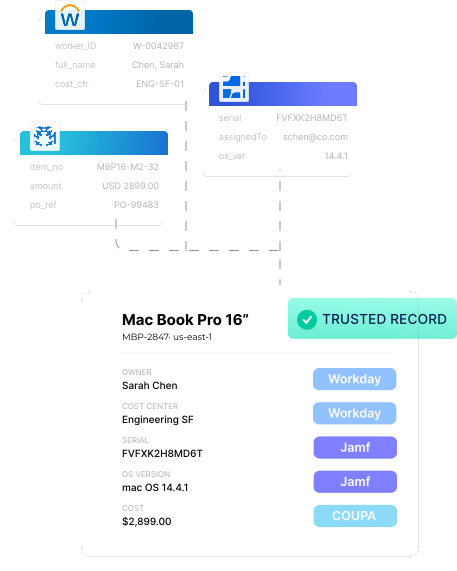
Connect every source system, reconcile them as they change, and normalize the data into one record.

Governed lifecycle
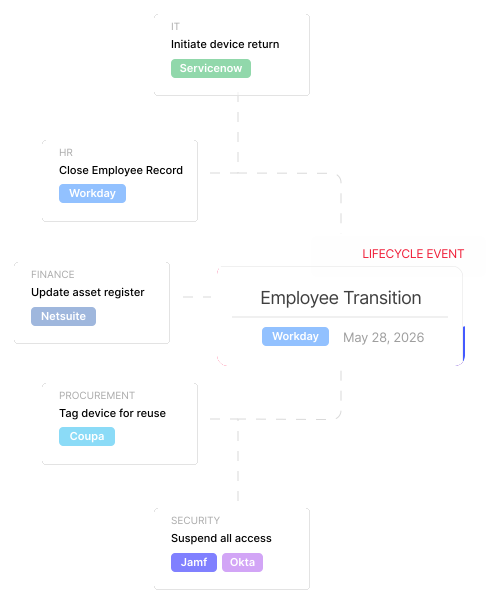
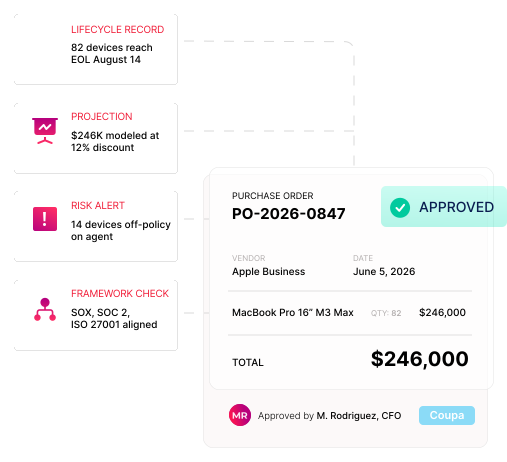
Trigger workflows on real events, orchestrate action across systems, and route approvals where they matter.

Defensible decisions
Document every change, generate audit-ready evidence, and forecast what’s coming so decisions hold up.
SOLUTIONS BY TEAM
One trusted view of hardware, wherever the work happens.
IT OPERATIONS
Spend less time fixing data and more time running IT.
IT Operations carries the cost of bad asset data: inaccurate tickets, broken workflows, and audit prep that drags on for weeks. Oomnitza keeps every record accurate so the team spends its time resolving, not reconciling.
SECURITY
See and secure every device.
Security teams catch and close exposure faster when every asset has a verified owner. Oomnitza ties every device to an owner and current status, so findings reach the right person instead of an unassigned queue.
FINANCE & PROCUREMENT
Plan, buy, and recover with confidence.
Finance and procurement plan, buy, and recover with confidence when the asset record reflects reality. Oomnitza ties every asset to an owner, a cost center, and a lifecycle stage, so budgets forecast accurately, purchases build on what’s already owned, and recoverable value isn’t written off.

End the weekly data cleanup.
Source-system signals flow into one normalized record continuously, catching drift the moment it happens instead of weeks later.

Have the right device waiting for every new hire.
Trigger procurement, assignment, and provisioning the moment HR creates the record.

Run service management on verified asset truth.
Accurate records flow in continuously, so incidents, changes, and requests reach the right owner and resolve the first time.

Tie every device to an active employee record.
Eliminate orphaned devices with credentials still attached to terminated users.

Revoke access the moment offboarding starts.
Trigger access suspension and device return from the HR event, not a ticket.

Push asset truth to your security tools.
Sync verified ownership data to your endpoint and identity systems continuously.

Forecast spend from authoritative data.
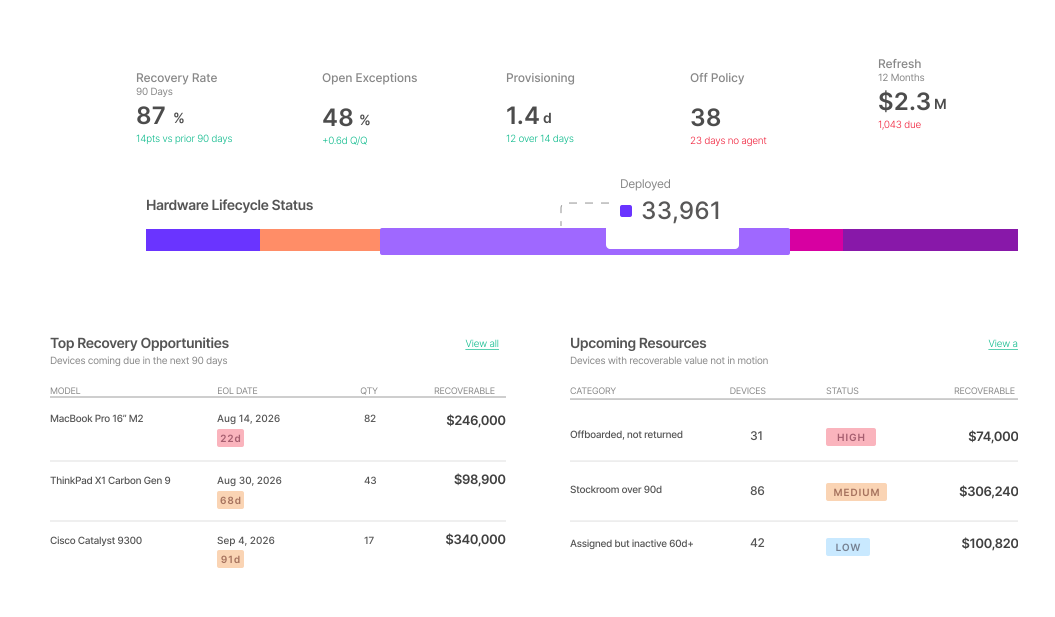
Project refresh cycles, recovery pipelines, and budget impact from real lifecycle data.

Recover hardware before it’s written off.
Surface recoverable devices early, with the context to route them back into circulation.

Stop paying for ghost assets.
Reconcile your hardware inventory against your depreciation schedule continuously.
CUSTOMER STORY
From eleven disconnected systems to one source of truth.
 |
||
| “Oomnitza gave us a single source of truth across our hardware estate. We finally have the visibility and the automation to run IT the way the business expects us to.”
Nemi George
VP, IT & Information Security Officer |
||
+30%Saved by recovering off-boarded employee devices |
175+Workflows automated across the lifecycle |
160 hrsMonthly hours saved, 25% operational cost reduction |
| READ FULL STORY | ||

INTEGRATIONS
Connect every system that holds a
piece of your hardware truth.
Every system that touches your hardware estate — procurement, identity, HR, endpoints, and finance — are connected and continuously reconciled.












RELATED SOLUTIONS
Unlock faster audits, lower spend, and tighter security
across the business.
|
|

Audit ReadinessMaintain continuous audit evidence across SOX, SOC 2, ISO 27001, DORA, and Essential Eight without the spreadsheet-based scramble before every review. |
| EXPLORE THE SOLUTION | EXPLORE THE SOLUTION |
|
|
|
| EXPLORE THE SOLUTION | EXPLORE THE SOLUTION |


Frequently Asked Questions
What is hardware asset management?
Hardware asset management is the practice of tracking, managing, and accounting for an organization’s physical IT assets across their full lifecycle, from procurement through disposal. Modern hardware asset management treats every device as a record that stays synchronized with HR, finance, security, and IT systems, so the data remains accurate as people and devices change.
What is the hardware asset management lifecycle?
The hardware asset management lifecycle spans every stage a device moves through from purchase to retirement: procurement, deployment, assignment, maintenance, refresh, and disposition. A complete program governs each stage with documented ownership, location, status, and chain of custody, so every device can be accounted for at every point in its life.
What is the difference between hardware asset management and a CMDB?
Hardware asset management focuses on physical asset lifecycle: ownership, location, status, cost, and disposition. A CMDB stores configuration items and their relationships, typically for IT service management. The two are complementary: hardware asset management keeps the asset truth that the CMDB depends on.
What is the difference between hardware asset management and endpoint management?
Hardware asset management manages the asset record across systems: who owns the device, what it cost, where it’s deployed, and what HR event it’s tied to. Endpoint management tools like Jamf, Intune, and CrowdStrike configure and secure the devices themselves. Oomnitza connects to endpoint management tools to keep the asset record in sync with device state.
Does Oomnitza Hardware Asset Management require agents on every device?
Oomnitza is agentless by design: asset data flows from your existing endpoint management, HR, identity, and procurement systems through native API integrations. Nothing to deploy to the device itself, which means no security review, no rollout schedule, and no maintenance burden as the fleet changes.
Do you need a discovery tool to do hardware asset management?
Discovery tools and hardware asset management solve different problems. Discovery scans the network to find devices that are connected. Hardware asset management holds the authoritative record across every device the business owns, on or off the network, and syndicates that record to other systems. Customers running discovery tools alongside Oomnitza send their findings into the Oomnitza record, where the data gets normalized with everything else the business knows about each asset.
Can hardware asset management track offline or off-network assets?
Yes, when the platform isn’t dependent on network discovery. Oomnitza tracks every asset the business owns, including spares in storage, devices in transit, pre-deployment stock, and offline equipment that network-based tools can’t see. Records are maintained from procurement onward, so an asset’s lifecycle is tracked even before it’s connected to anything.
How does hardware asset management support audits and compliance?
Hardware asset management produces the documented chain of custody auditors and regulators require: who owns each device, where it is, what’s installed on it, and what’s happened to it across its lifecycle. Oomnitza generates this evidence on demand for SOX, SOC 2, ISO 27001, DORA, NIS2, and Essential Eight, replacing audit prep work that traditionally takes weeks of manual reconciliation.
What types of hardware can Oomnitza manage?
Oomnitza manages endpoints (laptops, desktops, mobile devices), infrastructure (servers, storage, virtual machines), and networking hardware out of the box. The platform’s flexible data model supports custom objects, which extend coverage to IoT, OT, edge devices, and offline assets like spares inventory and pre-deployment stock.
What is the ROI of hardware asset management?
Hardware asset management delivers ROI through recovered hardware, eliminates spend on ghost assets, automation savings across HR, IT, and procurement, and reduced audit prep costs. Customers using Oomnitza have recovered hundreds of thousands of dollars in hardware and cut audit prep from weeks to days.
Explore more insights.
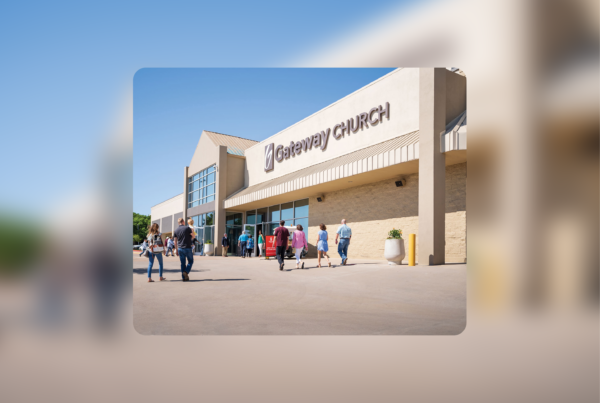
CUSTOMER SUCCESS STORY: GATEWAY CHURCH asset data accuracy, up from 50%down from one week, to support leadership questions and audit prepcampuses supported Gateway Church was quickly growing their ministries, scaling…
PDS HEALTH CUSTOMER STORY Cost Savings Managing AssetsHours Saved Per MonthMore Assets Discovered PDS Health wanted to elevate their asset management strategy for increased visibility and control. By improving their…

Broadband Communications Provider Customer Story A leading broadband communications provider was struggling to manage IT assets and budgets effectively due to unreliable inventory data and challenges in reclaiming devices from…

DOCKER CUSTOMER STORY minutes, down from 4 hours,
to automate onboarding for new employeesasset data accuracy for SOC 2 audit, with full confidence they’ll passfull-time IT employee saved
due to automated integrations…
Trust the data behind every
hardware decision.
Connect with our team to learn how Oomnitza makes it possible.