Building an IT Asset Data Foundation for AI-Driven IT Operations
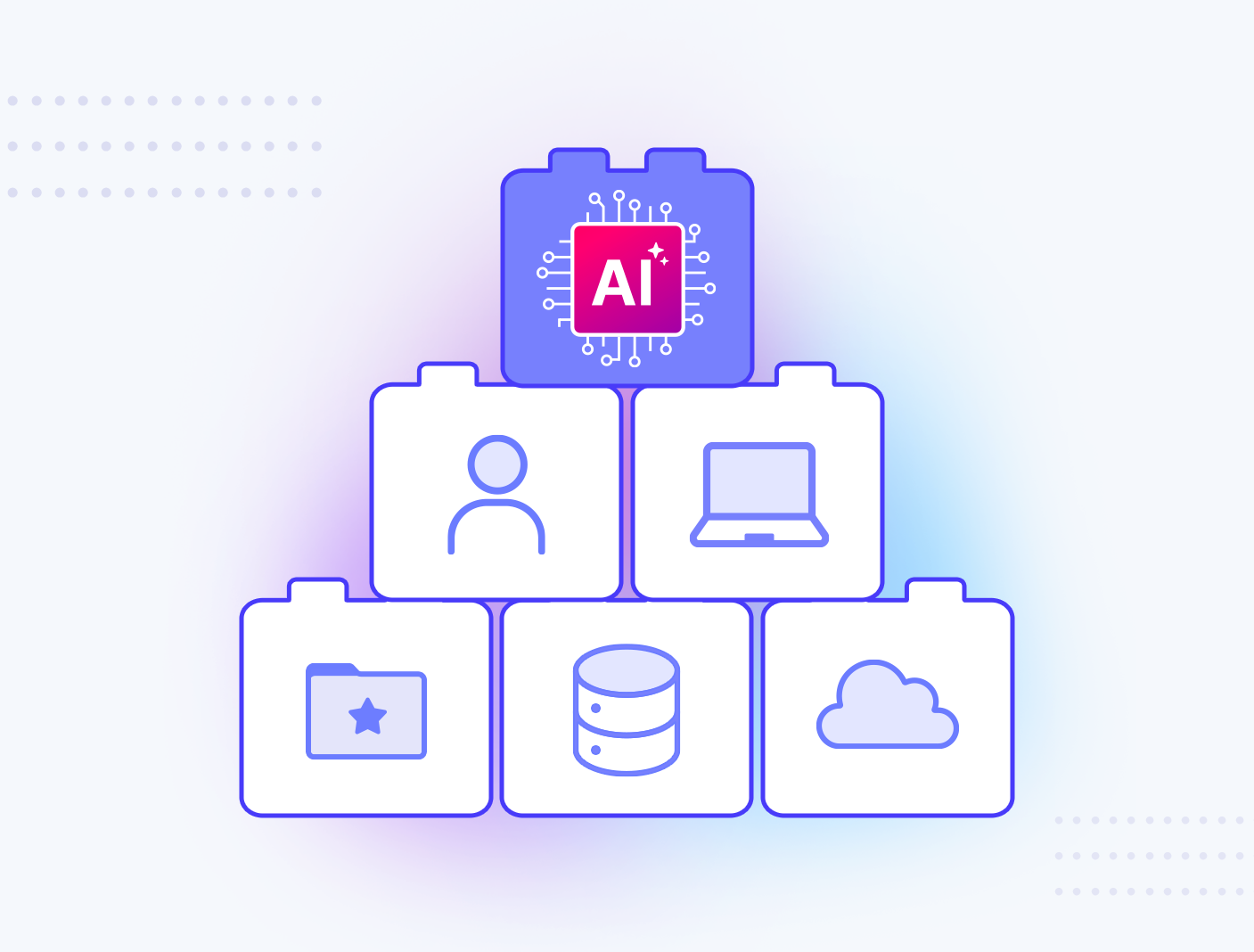
Table of Contents
KEY TAKEAWAYS
- Gartner projects that by 2028, 99% of I&O-led investment in agentic AI made without system data and operating model improvements will fail to achieve sustainable ROI. The problem isn’t the models. It’s the infrastructure data behind them: incomplete records, duplicate entries, and configuration data that’s months out of date.
- Agentic AI is proactive, making decisions and executing actions autonomously, so it amplifies whatever asset data it’s given. It doesn’t independently verify accuracy, which means feeding it fragmented or stale data compounds errors instead of surfacing them.
- Static CMDBs and legacy tools can’t sustain the data quality AI depends on. What agentic AI actually needs is a federated, normalized, continuously enriched asset data foundation that syncs in real time and stays auditable as infrastructure changes.
AI is the future of IT operations. However, even with heavy investment in automation and AI agents the last few years, many IT leaders have struggled to see the tangible benefits. One CIO surveyed for Top 3 Priorities for CIOs in 2025, a report from Evanta, a Gartner company, put it plainly: “People are struggling to find value in AI because their data is not structured, cleansed and mastered in a way that can be useful with AI.”
Agentic AI fails in IT operations for one main reason: the asset data feeding it can’t be trusted. Gartner projects that by 2028, 99% of I&O-led investment in agentic AI made without system data and operating model improvements will fail to achieve sustainable ROI. The root cause sits in the infrastructure data behind the models: incomplete records, duplicate entries, and configuration data that’s months out of date.
Before deploying intelligent agents across your infrastructure, there’s one foundational question every IT leader should ask: Can you trust the data those agents will rely on?
To understand why data readiness is so critical—and so often overlooked—it helps to look at how agentic AI works, and how different it is from the AI most organizations are used to.
In this blog, we will explore the critical importance of establishing a foundation built on accurate, complete IT data that supports AI initiatives and empowers IT teams to leverage technology that transforms their operations.
What Makes Agentic AI Different From the AI You’ve Already Deployed
Understanding why data matters so much starts with understanding what agentic AI is—and how it differs from other, more familiar types of AI.
Agentic AI refers to autonomous or semi-autonomous software entities that perceive, decide, act, and achieve goals with little to no human intervention. These agents combine large language models (LLMs), natural language processing (NLP), machine learning, reinforcement learning, and knowledge representation to operate independently in digital and physical environments.
These agents need context to operate effectively. They rely on underlying infrastructure data about assets, dependencies, and relationships to make accurate decisions. Without that foundation, even the most sophisticated AI will produce flawed or risky outcomes.
Gartner
“AI agents are poised to disrupt the IT operations ecosystem by breaking down product silos. Consumption of future ops functionality will occur via collaborating, cross-discipline agents that will produce superior outcomes.”
Agentic AI vs. Generative AI at a Glance
Generative AI | Agentic AI | |
Behavior | Reactive, responds to prompts | Proactive, initiates independently |
Output | Content, summaries, insights | Decisions and executed tasks |
Human Role | Reviews output before use | Little to no intervention required |
Best For | Content generation, analysis | Autonomous operations, remediation, orchestration |
Why Agentic AI Depends on Trusted IT Asset Data
Unlike generative AI, which reacts to prompts to produce content or insights, agentic AI is proactive. It can make decisions, take actions, and solve problems on its own. These agents are designed to operate through sequences of logic and learning—constantly adapting as they interact with systems, data, and users.
When implemented with the right foundation, agentic AI can offer I&O teams significant benefits. These agents operate continuously, scanning and analyzing massive volumes of data at machine speed. This allows IT teams to redirect human resources toward higher-value initiatives and strategic decisions.
This technology is also designed to perform specific tasks and run in the background of the programs it supports. The algorithms can be built to meet each program’s unique needs, and that specialization increases their effectiveness across I&O functions.
As I&O teams use agentic AI over time, they will typically see the technology’s impact in three key areas. Each one depends on the same thing: the accuracy of the data behind it.
The Benefits of Agentic AI
1. Accelerated Innovation and Strategic Differentiation
AI agents support cost efficiency by performing tasks in seconds that once took days. They also unlock strategic differentiation—testing new ideas, optimizing operations, and enabling tailored responses to specific user or business needs. This flexibility allows teams to focus more precisely on high-impact segments and initiatives. However, none of that speed matters if the agent is optimizing against the wrong asset record.
2. Enhanced Productivity and System Performance
Agentic AI’s advantage over scripted automation is that it adapts in real time instead of following a fixed set of rules. As agents tune platforms, workflows, and assets to match actual demand, they improve system performance, increase visibility into IT infrastructure, and reduce waste during demand spikes. That real-time adaptation only helps if what the agent is adapting to is accurate.
3. Greater Resilience and Customer Experience
According to Gartner, the top challenges facing I&O teams include aligning with business goals, building critical skills, and improving customer experience. Agentic AI helps address these gaps by using existing infrastructure and assets to better interpret workload demands, support real-time service delivery, and adapt to shifting priorities—enhancing both resilience and end-user satisfaction. Each of these outcomes assumes the agent’s picture of the infrastructure is current. When it isn’t, resilience becomes a liability instead of a benefit.
These outcomes are powerful—but they all depend on one critical factor: the accuracy, completeness, and trustworthiness of the data that powers the AI.
The Hidden Risks of Inaccurate IT Asset Data
Most I&O teams don’t have the clean, complete, and consistent asset data they need to support agentic AI. Even the most advanced models will fail if the information they rely on is inaccurate, fragmented, or out of date.
And yet, many organizations continue to depend on legacy systems—like static CMDBs—that were never designed to keep up with today’s dynamic IT environments. The result? A growing gap between AI ambition and operational reality.
Running agentic AI on poor-quality data can lead to:
- Incorrect Actions: AI agents take the wrong actions when working on outdated or misleading data resulting in faulty decisions, unnecessary alerts, or misrouted workflows.
- Reinforced Bad Patterns: Poor data introduces systemic bias into AI agents, reinforcing flawed patterns and compounding errors over time.
- Loss of Specialization: Without quality data, agents become overly generalized, unable to adapt to edge cases or new conditions reliably.
- Limited Scalability: When foundational data is untrustworthy, agentic AI can’t scale reliably across systems or environments.
- Service Disruptions: Inaccurate asset or dependency data increases the risk of unexpected outages and operational slowdowns.
- Security Gaps: Poor visibility into assets and their configurations opens the door to vulnerabilities and missed threats.
- Cost Overruns: Recovery from AI-driven errors caused by bad data often requires manual fixes, rework, and delayed projects—draining time and budget.
These problems show up daily for teams relying on systems that weren’t designed to maintain accurate, federated, automation-ready data.
Why IT Asset Data Is Still Failing AI
Despite major investments in IT tools and automation, most organizations still struggle to access and maintain trustworthy asset data. Siloed systems, manual processes, and legacy architectures make it difficult to deliver the kind of real-time, accurate, and enriched data that agentic AI requires. To move forward, I&O leaders must rethink their approach to data management—starting with a clear understanding of what’s holding them back.
Disconnected Systems and Siloed Data
Many organizations have adopted a wide range of best-in-class tools—each solving a different problem but rarely speaking the same language. As a result, IT asset data lives in disconnected systems, each with its own definitions, update cycles, and blind spots. Even when I&O leaders can access the data, it’s often incomplete, duplicated, or stale—making it unfit for automation or AI.
These silos not only obstruct cross-functional visibility and impact analysis, they also create friction for basic operational needs like security audits, compliance checks, or infrastructure optimization.
Inadequate and Outdated CMDBs
CMDBs were designed to serve as the “single source of truth” for IT asset data—but in today’s dynamic environments, they often fall short. Manually maintained and disconnected from real-time operational systems, most CMDBs contain outdated, duplicated, or incomplete information.
Gartner warns that these gaps can seriously undermine IT service management—leading to inaccurate impact analysis, delayed resolution, and inefficient change management.
Gartner predicts
“By 2028, large enterprises using AI-powered, real-time discovery and dependency mapping will see 30% fewer outages than those still relying on manual CMDB updates.”
The takeaway is clear: maintaining data accuracy through static systems and periodic updates isn’t sustainable at the pace modern infrastructure moves.
Legacy Tools That Can’t Keep Up
Many legacy IT systems were built for a different era—before ephemeral assets, multi-cloud environments, and real-time automation. They often lack integration capabilities, require manual upkeep, and run on outdated or unsupported software.
Instead of supporting agility, these tools introduce friction: slowing down data updates, increasing reliance on overworked admins, and making it nearly impossible to establish a current, connected, and complete view of IT assets.
Below are concrete steps I&O leaders can take to close this gap and build the data foundation agentic AI programs need.
How to Build a Data Foundation AI Can Trust
Most IT organizations treat asset data as something to store in one place and update by hand. That model breaks down fast in dynamic environments. Static CMDBs, spreadsheet audits, and patchwork integrations can’t keep up with the velocity and complexity of modern infrastructure.
The only sustainable way to support agentic AI is with a trusted data foundation that is:
- Federated, not centralized – pulling data from where it lives, rather than forcing it into a single system.
- Normalized and triangulated across systems – so conflicts, duplicates, and discrepancies are resolved at the source.
- Continuously enriched – with new context and attributes that make the data more useful to automation.
- Synchronized in real time – so that updates flow across systems, not just into a dashboard.
- Auditable and trusted – so teams have confidence that the AI isn’t acting on guesswork.
Building a strong data foundation isn’t a one-time effort. To ensure long-term trust and accuracy, organizations need continuous feedback loops—systems that detect changes, surface anomalies, and trigger corrective actions automatically.
Frequently Asked Questions About IT Asset Data Foundations
1. What is agentic AI in IT operations?
Agentic AI refers to software agents that perceive, decide, and act with little human intervention. It combines LLMs, machine learning, and reinforcement learning to manage IT infrastructure autonomously. Unlike generative AI, which responds to prompts, agentic AI takes independent action based on the asset and infrastructure data it can access.
2. Why do agentic AI projects fail in IT operations?
Most agentic AI projects fail because the underlying asset data is incomplete, duplicated, or outdated. Gartner projects that 99% of I&O-led agentic AI investments will fail to deliver sustainable ROI by 2028 without improvements to system data and operating models.
3. What’s the difference between a CMDB and an asset intelligence layer?
A CMDB is a static repository that stores configuration items, typically updated manually or on a schedule. An asset intelligence layer continuously aggregates, reconciles, and validates data from every source system in real time, so the record stays current instead of drifting out of date between updates.
4. What does “AI-ready” IT asset data actually require?
AI-ready asset data is federated rather than centralized, normalized and reconciled across systems, continuously enriched with new context, synchronized in real time, and auditable, so every action an AI agent takes can be traced back to verified information.
5. Can agentic AI fix bad asset data on its own?
No. Agentic AI amplifies whatever data it’s given. It doesn’t independently verify accuracy. Feeding agents unreliable asset data compounds errors rather than correcting them, which is why data quality has to be solved before autonomous agents are deployed, not after.
Fuel Agentic AI with Data You Can Trust
The benefits of agentic AI are real—but so are the risks. Inaccurate, incomplete, or outdated asset data will derail even the most ambitious AI initiatives. For IT leaders, success depends not just on adopting intelligent agents, but on feeding them the kind of data they can actually trust.
That requires a shift: from static repositories to federated, normalized, continuously enriched data that flows across systems and reflects the real state of your environment. This is the foundation that makes AI not just possible, but powerful.
The organizations that win with AI and automation will be the ones running their ITAM processes on operational intelligence they can actually trust. See what that trusted asset intelligence layer looks like in practice.